Monday, 30 September 2019

Why Safe Spaces Don't Really Exist


This week the University of Edinburgh has been criticised for hosting an “anti-racism” event in which white people were due to be banned from asking questions. The conference was organised by the Resisting Whiteness group, which opposes racism and describes itself as a QTPOC (queer and trans people of colour) organisation. There are apparently two “safe spaces” at the event - and for one of which, white people will be barred from entering. The report said "the safe places are meant for those who feel “overwhelmed, overstimulated or uncomfortable”. Their aim is to “amplify the voices of people of colour" by not be giving the microphone to white people during the Q&As.

While the intentions are deeply disturbing, and indicative of a failing culture, I actually think the concept of safe spaces is a dubious one - there are not really any safe spaces, at least not at the intellectual level in universities. A place of sanctuary is a viable safe haven, such as for groups of addicts or women recovering from domestic abuse, but there are no real safe spaces in terms of intellectual ideas.
 
It's not just that attempted safe spaces stifle thought and erode free expression - the people within the walls of their self-constricted safe spaces are never really protected from what lurks beneath the sub-ducts of their psyche and their despair at being incarcerated in such a constricting mental prison. The walls they have erected to protect them from the outside are full of cracks into which those outside things leak anyway - you are never safe from the dangers of retarding truth, nor from the loss of the liberation gained from discovery and from the exploration of ideas. People who like the sound of intellectual safe spaces should be very careful what they wish for - it's going to feel like hell in the end.

Saturday, 28 September 2019

This Is One Of The Cleverest Memes Of The Year (If Not Ever) - The Reaction It Has Engendered Is Absolutely Priceless


“Islam is Right About Women.” This meme stuck on a signpost in America shows better in five words what it takes some commentators thousands of words to capture - it is a brilliant piece of provocation that so acutely digs in to the current zeitgeist that it's possible to offend groups on opposing sides, bewilder groups on opposing sides, and leave people quite unsure how to respond to it. When words have this much power, social media is rather exhilarating.

“Islam is Right About Women.” - It bewilders people from all ideological groups because it is cleverly vague enough to be devoid of any precise meaning, but clear enough to elicit some kind of negative emotion.

Islam is Right About Women.”  - It has the power to offend the snowflakes, because they are always offended at anything like this, without ever knowing why, or whether they should be.

"Islam is Right About Women.”  - It has the power to offend the feminists, because 'Hello, Islam and women' - this sign can't be right!

“Islam is Right About Women.”  - It has the power to offend misogynists (either Muslim or otherwise) because they would see the sign as an ironic attack on the oppression of women.

"Islam is Right About Women.”  - It has the power to offend the radical left, because they'll see it as both Islamophobic and misogynist, while at the same time being puzzled because they think it ticks a diversity box.

It is a truly brilliant meme: it offends all the right people, yet leaves them unsure about quite why they are offended - which almost perfectly encapsulates the modern bipolarities of extreme snowflakery on the one hand, yet radical, uncompromising, intolerant entitlement on the other.


Monday, 16 September 2019

Children's Futures Are Being Damaged, And There Is Going To Be A Real Price To Pay In Their Adulthood


Parents, be warned! Young children are currently being damaged in two big but insidious ways. The first real damage is the creation of offence culture, where young people are growing up in a world in which many of them will be overly-entitled and ill-equipped to think and speak freely, explore subjects with open rigour, be too lily-livered to cope with proper scrutiny of beliefs and ideas, and demand special intellectual privileges that their opinions and beliefs simply do not deserve (I've written about this before)

In order to say things of importance you have to take risks, you have to be courageous, you have to risk offending, and you have to make challenges to ensure that there is no false security or complacency in consensual opinion. In other words, to be profoundly right, you have to be prepared to be profoundly wrong, a fool, an outcast, even a disgrace sometimes. You have to be free enough to be able to say what others might also be thinking but haven't yet said.

A society that puts people in gilded cages and encourages them to lock the door from the inside is not only fostering an environment that suppresses speech, it is also fostering an environment that suppresses thought, because we do lots of our best thinking from talking and sharing ideas and hearing feedback. A society that makes people craven about speech makes people craven about ideas, because it keeps a lot of our best stuff locked away in the safe space of our cranium - unexpressed, and therefore unfulfilled.

Seek the truth and you will never be afraid to hear anything, because you can't lose: if something offensive or heterodoxical comes along, it is going to be evaluated through your robust truthseeking lens - and if it adds any value by way of a corrective you will modify your view to an improved state, and if it merely reinforces your view stronger, you will have an even more robust opinion, and a better defense of it. You have to be free to explore ideas and express them, because it’s only by expressing ideas and talking about them that we have a full capacity for learning. You have to be free to offend, and free to speculate in bold ways, and your children will pay a big price for attempts to stultify that.

The second real damage is the damage that is being done to children with their understanding of identity and biology. In the news this week we see that the BBC has told teachers who work with children aged 9-12 that there are “100, if not more” gender identities. We even see cases where people are threatened with prosecution if they declare a view that there are only two sexes or two genders. Already, we read that children are seeking in record numbers to change their gender, because they erroneously feel they were born in the wrong body - and this is only going to get worse.

Society, like riding a bike, is about balance - and on this issue there needs to be a better balance struck between being empathetic and supportive when people don't fit in to a simple binary categorisation, and not becoming hysterically reactionary with every fad and obscure belief system, some of which seem powerful enough to confuse children about their core identity, and even in some cases their core biology.

Many of society’s socio-political hot potatoes are more to do with rooted human behaviour than they are the issues themselves. You’ll find most people like to operate from within a safe, simplistic framework that rewards them with an easy model for analysing the world, and causes discomfiture when things happen that do not fit into that worldview. 

This, I think, is what is happening with the gender fluidity debate - something upon which I have rarely commented, until now. Over-simplicity from within a safe, uncritical framework does not leave you well equipped to deal with the world competently, but neither does uncritically accepting the most foolish things in common parlance just because they happen to be in vogue. I'll bet the average person on the street does not know very much about the differences between sex and gender, yet they comment in highly politically charged circles as if they do. It is important not to use sex and gender interchangeably. Sex is determined on the basis of biological apparatus (principally genitalia) and gender is to do with the associative socio-personal phenomena in partnership with sexuality. To that end, men and women are different in both categories.

To recap on the genetic differences that constitute sex; men and women both have 46 chromosomes, and 2 sex chromosomes. Women have 2 X chromosomes, and men have 1 X chromosome and 1 Y chromosome. The Y chromosome in dominant, and causes the formation of male biological apparatus. XX and XY differences also engender the variances in hormones (principally oestrogen and testosterone), and these bring out the physiological and biological differences between males and females.

The gender differences, on the other hand, are to do with perceived masculinity and femininity. If you look at male and female personalities in totality, their similarities far outweigh their differences, but there are plenty of differences too, and these play out in their respective relationships, attitudes, careers and priorities (to name but four). Personality differences are significant, but they are not the same as sex differences - hence sex and gender should not be used interchangeably - and the fact that they so often are is not helping the debate, especially for our children.

There are, of course, people who identify as transsexual and who want to change sex. We had a guy like that in our snooker team in the 1990s - born a male, but felt he was a female, and had sex reassignment surgery. These conditions are complex, especially when you consider emotions and psychology. But because of the desire to be either one sex or the other, most intersex people choose to be identified as either a male or a female.

That should not, however, be used to pander to the whim of every attention-seeker who wants to be referred to with fictitious, biologically fantastical gender pronouns - and you are certainly not helping children by being complacent about an insidious environment that makes these crazes commonplace, and gets kids questioning their own biological identity to follow a trend.

When you have situations like the '100 genders' debacle in schools, where facts, feelings, offence, entitlements and perceived rights are sowing so much confusion into the minds of children, and provoking hostility into the minds of teenagers and young adults, you are going to end up with a toxic combination where people don't know truth from falsehood, and are furtive about how free they are to express their views about either. Because these problems are setting in to lives at such a young age, there is a real danger that the generation that follows this one will be more bewildered and maladapted than they can realistically cope with - and that is going to be a big problem.


Monday, 2 September 2019

On Meat Consumption & Climate Alarmism


I’ve been reading a few of the silly scare stories, like this one, that insist we should stop eating meat or else the planet is going to hell in a handcart. Articles like that get just about everything wrong, mostly by failing to measure benefits as well as costs (the perennial sin), but also by paying zero regard to future technological developments that will revolutionise solutions to the problems we currently think we are trying to solve.

But quite apart from that, I had another tangential thought. As a meat eater, I wonder if future generations will look back on our meat-eating habits in the same way that we look back on the human history of slavery and racism, and be utterly disgusted by it. I wonder if, before our very eyes, we are slowly seeing the death of a meat-eating industry that kills billions of chickens, pigs, sheep and cattle each year, towards a point in the next few generations where nobody eats meat.

Think about how things have changed even in the past four or five decades: there are increasing numbers of vegetarians and vegans, and more campaigners against animal cruelty and for animal rights – perhaps that trend will continue with every new generation until no one eats meat anymore. With more vegetarians, there will be a greater demand for vegetarian dishes, and more competition to provide them, which should improve the quality and diversity of vegetarian cuisines (as has happened already in the past couple of decades – I mean, think how many frustrated carnivores have been rescued from the circumscribed veggie-wife/husband’s preferred dining outlet with the wonderful but solely viable option that is halloumi).

What I suspect will also happen is that meat will start to come from the lab rather than the animal, where synthetic meat is grown from stem cells, and will reach a point where the process is cheap enough for us to buy it in supermarkets as part of our weekly shop. In other words, technological innovation will sort out the meat problem, bring cessation to the killing of animals, and have future generations looking back on our meat-eating practices as barbaric.

It's strange how morality evolves in different directions, where some things in the UK that were once seen as acceptable become abhorrent (like slavery), and some things that were once seen as abhorrent become acceptable (like homosexuality). Meat-eating will probably be an example of the former - but when we can grow synthetic meat in the lab and mass-produce it for widespread consumption without killing any animals, our descendants will probably look back on us rather like how we look back on the child labour practiced by our progenitors – that it’s unfortunate, but that back then we didn’t know how much better we could do.  

Wednesday, 14 August 2019

On The Nature Of Free Will & Determinism


In 2011, I wrote a paper on the nature of free will and determinism - dispelling some common myths about the two terms, and hopefully providing a fresh and enlightening perspective on some complex but intriguing matters. Eight years later I decided to touch it up a little. For anyone interested, here is the new version, made up of the following sections.

Part I - Define your terms properly
Part II - Lenses of Determination
Part III - The First and Third Person Self
Part IV - Determinism unpacked
Part V -- What would it be like to know the whole universe?

Read the full paper here.

Wednesday, 7 August 2019

This Is My New Favourite Teenager


I've just found a contender for my new favourite teenager. And no, I don’t mean that little madam Greta Thunberg (about whom I’ve been about as critical as I could get away with towards a teenage girl who doesn’t really know much yet) – I mean the teenager called Felix Kirby who wrote this article - Teenage Climate Change Protestors Have No Idea What They’re Protesting - and who gets pretty much everything right about how young climate change activists haven't really got a clue about what the heck they are doing.

Here are three of the article's quotes from the bright young Felix:

1) "Global-warming research is a hugely complex field, and it’s unlikely that any ordinary person—let alone a minor—would have any real grasp of it. Nor would they be able to appreciate the uncertainty that characterizes our understanding of how today’s human activity will affect the future state of the earth’s climate."

2) "As a teenager, I fully understand the mindset of young people. We’re predisposed to leap before we look. This is borne out by neuroscience. Our prefrontal cortices, which regulate (among other things) decision-making, planning, self-awareness and inhibition, do not fully develop until we are in our mid-20s. Until then, we have difficulty analyzing the long-term consequences of our actions. The upshot is that many young people tend toward reckless behaviour. "

3) "Given the inconclusive state of contemporary climate science, we can’t be sure; and, until we absolutely do know the truth, we should hold off on drastic action. Encouraging mobs of young people to join the climate-protest movement only adds a spirit of social panic to an issue that already is extremely tangled."

You should read Felix's whole article - he's precocious and showing lots of promise in a world awash with reactionary, overly-simplistic thinking Greta Thunbergs. It's unsurprising that young climate change activists don't know what they're talking about - the older climate change activists don't know what they're talking about either, and the nonsense is just being passed down. Older green activists (like Rupert Read, George Monbiot and Caroline Lucas) are regularly giving talks and writing articles explaining how we are letting down our youth and leaving them a calamitous future worthy of grave foreboding. Here is what I would say to any young person who happened to be listening.

Dear Young Person,

Contrary to the scaremongering you’re likely to see about future climate damage, and the crippled world you’re going to inherit – I want to tell you how I really think it is. You are so privileged to be alive in a UK like the one you’re in today. You are reading this in one of the top dozen countries that has ever existed, and by virtue of living here, you are among the top 0.01% of the richest people who has ever lived on this planet. It is only because of your extraordinary riches and prodigious standard of living that your life is luxurious enough to consider things like climate change and future generations.

Most humans who have ever lived had no such luxury – they spent most of their time with hardly enough to eat, with debilitating, vomit-inducing diseases, infant mortality, with almost no technology, and almost no comfortable leisure time. Even basic things like electricity, gas, running water, regular food and drink, relative safety, rule of law, property rights and central heating would have been unimaginable to them. You are so blessed to have the luxury to ponder climate change – you can do so only because your recent forebears worked so hard, and shared so many ideas, that you’ve been liberated from most of the harshest, devastating scenarios that plagued our pre-industrial progenitors.

The main reason climate change seems so terrible is because, relative to its problems, so much of the world is so well off, and so many people are so prosperous, that we can hardly believe how rich we are. Living in the UK, you have stable floors, walls and a roof, carpets, heating, running water, a shower, a toilet, a garden, a car, legal rights, food in the cupboard, and almost none of the fungi, bacteria, insects, and rodents that would have once infested your home. Just having access to clean water and a toilet protects you from the numerous sanitary problems that would have been lethal just a short time ago.

In your kitchen you have white goods that enable you to store, refrigerate and freeze food, cook with ease, wash your clothes and dishes. In your bathroom you have the means of keeping clean, and sanitary goods, cleaning products, detergents, and medicines that protect you against things that would have once killed you. Every day you go out with clean clothes, clean teeth, and a relatively clean bill of health. And furthermore, most of the things that do contribute to climate change are the things that have conferred such mass benefits on our species – homes, schools, hospitals, shops, factories, churches, care homes, universities, industrial activity, entertainment industries, leisure, travel, social interaction, cars, trains, planes, boats and digital technology - that it would have been impossible to have progressed to the degree we have without them.

You are being told that all those benefits have contributed to global warming – and that is true – but you are not being asked to think enough about the immense benefits that the concomitant economic growth and technological innovation have brought to bear on our increased standards of living, on human relationships, on increased human knowledge and understanding, on higher life expectancy and lower infant mortality, on lifting people out of poverty, on improving the GDP of developing countries, on healing the sick, and on reducing suffering and misery – you are being told none of this because they are trying to avert your attention from a much bigger and more informative picture that doesn't fit in with their biased, ideological agenda.

Think of it this way: no one sane would look at our industrial history in the past 100 years and assume that the mass lifting people out of poverty, the economic growth, the enhanced technological innovation, the higher life expectancy, and the increased standards of living amounts to an argument that the governments need to ‘do’ something to stop these activities. Therefore no one sane should look at the costs of our industrial activity and assume that the governments need to ‘do’ something. The reason should be obvious: if the government ‘does’ something to help with the latter, it needs to do so without bringing about negative unintended consequence against the former – and that is not going to happen. Not only will the government action certainly impede our economic progress, it will also certainly misallocate resources, provoke numerous opportunity costs and ‘unseen’ lost opportunities, and make decisions blindly that future history will show to have been gross misunderstandings of reality.

To add weight to this, the Heritage Foundation have confirmed that there is a positive relationship between a country's economic freedom and its environmental performance. Fifteen years of rigorous data analysis confirms that the more economic freedom, the greener the country. Economic freedom is good not only for increased prosperity and higher standards of living - it is good for environmental improvement too. The trade-off isn't between market growth and environmental protection, it is between government suppression of freedom and environmental protection. The freer the county, the more economically innovative it is, the more ideas there are exchanged, and the more chance there is to make energy cleaner and more efficient.

Ranking the countries from freest to least free (in quartiles):


Then with this scatter plot we find that for every one point increase in the Index of Economic Freedom, there is a 0.96 point increase in the Environmental Performance Index:
 
One factor that could mislead the above correlation would be if the countries scoring highest on the Index of Economic Freedom are “exporting” their polluting industries to poorer countries, thereby artificially increasing their score on the Environmental Performance Index. But some further research shows me that that isn't the case either:
 
 
Looking at human history in the past 100 years, it ought to be obvious that the benefits of our industrial industry so overwhelmingly outweigh the costs that have come alongside them - the only thing not yet established is by how much? 99.9% benefits for every 0.1% costs; 99% benefits for every 1% costs? I'm not sure - the analysis is really complex with lots of unknowns ,but I'll bet it's something like that, because you have to factor into the equation how much our trade and innovation engenders the routes to solutions that solve problems. But once you undertake as comprehensive an analysis as you can muster - you'd have to be pretty blinkered to fail to see the orders of magnitude by which the benefits of our industrial progress and economic growth far outweigh the costs the living things on the planet have incurred alongside it.
 
Yours Fraternally,
 
James Knight (The Philosophical Muser).


Monday, 5 August 2019

Cover Versions That Are Better Than The Originals


Although it’s all subjective opinion (or is it?), most cover versions aren’t a patch on the originals (and that’s even truer when it comes to movie remakes) – but occasionally a cover version bucks the trend and either slightly improves on the original, or in some cases blows it out of the water. There aren’t many, but here is my list of cover versions about which I think that applies – divided into four categories:

Category 1 - The original is ok, but the cover version is better
Soft Cell, "Tainted Love" (Gloria Jones)
Urge Overkill, “Girl, You'll Be a Woman Soon” (Neil Diamond)

Category 2 – The original is good, but the cover version is even better
Aretha Franklin, "Respect" (Otis Redding)
Mark Ronson ft. Amy Winehouse, "Valerie" (The Zutons)
Matthew’s Southern Comfort, “Woodstock” (Joni Mitchell)
Yo La Tengo, “You Can Have It All” (George McRae)
Eva Cassidy, “Over The Rainbow” (Judy Garland)

Category 3 - The original is ok, but the cover version completely blows it out of the water
The Beatles, ‘Twist and Shout’ (The Isley Brothers)
The Animals, ‘The House Of The Rising Sun’ (Traditional)
Sinead O'Connor, "Nothing Compares 2 U" (Prince)
Led Zeppelin, “Babe I’m Gonna Leave You” – (Joan Baez)
Led Zeppelin, “Dazed and Confused” (Jake Holmes)

Category 4 – The original is great, but the cover version completely blows it out of the water
Jimi Hendrix, "All Along the Watchtower" (Bob Dylan)
The Stranglers, “Walk On By” (Dionne Warwick)
Jeff Buckley, "Hallelujah" (Leonard Cohen)

Now my top 5
1) The Stranglers, “Walk On By”
2) Jimi Hendrix, "All Along the Watchtower"
3) Led Zeppelin, “Dazed and Confused”
4) Aretha Franklin, "Respect"
5) Jeff Buckley, "Hallelujah"

Any further contenders that you’re outraged I’ve precluded, do let me know.

Wednesday, 31 July 2019

A Great Example Of How Not To Reason


A reader called Cecil Hughes responded to one of my recent climate change articles, calling into question whether I'm really an earthling:

"Dear Mr. Knight, Having read your article on climate change I begin to wonder if we are living on the same planet. You may be interested in this article by Mark Lacey which I have recently discovered."

Here is my response to Mr. Hughes:

Thanks for sharing, Cecil. I’ve read it during my lunch. It’s good that you gave this article as an example of one I need to read, because it’s a perfect case that demonstrates how to get an analysis utterly wrong. Here’s why. Mark Lacey says:

“Alternative energy sources to fossil fuels have been around for many years. Wind, solar and tidal power have all been harnessed to a greater or lesser extent by numerous countries around the world. But we think that the transition to renewable energy is set to pick up speed rapidly - renewables are now competitive with fossil fuels in terms of cost. Consumers are demanding that this happen, and are voting with their feet as demand for electric vehicles (EVs), for example, soars."

I’m deeply sceptical that if a full cost-benefit analysis was undertaken, renewable sources of energy really have now reached all-in cost parity with fossil fuels. But if we take the best-case scenario, that the claim is indeed true, then businesses will voluntarily switch to renewable energy for any new venture, and consumers will follow suit by reaping the benefits of lower prices. In the meantime, if that reduces demand for oil, natural gas and coal, prices for fossil fuels will drop, so that they will either become the more economically efficient source of energy again, or renewables will win out, and the greens will be happy.

Either way, the price system associated with supply and demand will be the driver in consumer activity. Both businesses and consumers have an incentive to operate under the law of parsimony, using the fewest and cheapest resources possible – so if it really is true that renewables are now price competitive with fossil fuels in terms of cost, it doesn’t leave governments with much else to do here. The greens can enjoy a market-led efficiency that favours renewables.

But alas, I suspect that’s not the full story – and this highlights why I’m always going on about requiring a full cost-benefit analysis that factors in *all* considerations. Firstly, the article makes no mention of the cost of all business switching from fossil fuels to renewables – which will almost certainly prove cost-ineffective. If renewables really are now price competitive with fossil fuels in terms of cost, then there is incentive for new businesses and future investments to switch to renewables - but that does not mean businesses whose heavy capital investments are currently in fossil fuels will benefit from switching.

Secondly, I strongly suspect in typical sleight-of-hand manipulation from green commentators that the claim that renewables are now price competitive with fossil fuels is really a false economy, because I’ll wager that this analysis totally ignores all the taxpayers’ costs that have been lost in the renewable energy crony capitalist sector, where rent-seeking, lobbying and misallocation of resources is rife.

For example, we read from Mark Lacey that “since 2013 more than $1 trillion has been invested in renewable energy around the world and the industry now provides nearly 10 million jobs.” – and by ‘invested’ they always really mean a lot of that is taxpayer money that has been taken from the public to fund the costs of the renewable energy sector, which therefore does not demonstrate that it is providing value. Value is not demonstrated when money has to be taken from people in order to pay for things. The author makes an inadvertent back-handed hint at this when he says “Of course, renewables have been around for a while, but they have either lacked government support, or proved too expensive, or consumer demand hasn’t been there.” Quite. The taxpayer money that was pumped into these projects was done so precisely because they lacked support and would otherwise be too expensive.

I remember reading a New York Times story that celebrated the fact the solar industry employs far more Americans than wind or coal: 374,000 in solar compared with 100,000 in wind, 160,000 in coal mining and coal-fired power generation, and narrowly behind natural gas, which employs 398,000 workers (in gas production, electricity generation, and petrochemicals). The article writer was trying to insist that this must be a good thing for solar power, because it demonstrates how important solar power is in creating jobs. Alas, anyone who understands economics would not reason this way - they'd instead reason that solar power presently shows itself to be a pretty unresourceful and inefficient part of the energy industry.

And once you then compare number of workers to energy output as a percentage, things look even worse for solar energy. 398,000 natural gas workers amounts to 33.8% of all electricity generated in the United States and 160,000 coal employees amounts to 30.4%, whereas 374,000 solar workers amounts to just 0.9% of total electricity. If you try to break that down to electricity generated per worker, then coal generates 7,745 megawatt hours of electricity per worker, natural gas is 3,812, and solar is a measly 98 megawatt hours of electricity per worker. That is to say, producing the same amount of electricity requires 1 coal worker, 2 natural gas workers and a whopping 79 solar workers.

To put that into perspective, it would be like having three large supermarket chains across the country, producing the same output, but Supermarket A does so with 300,000 workers, Supermarket B does so with 600,000 workers, and Supermarket C doing so with 23.7 million workers, and the state subsidising Supermarket C because it thinks it provides better value than A and B. Solar energy is, at present*, showing itself to be a wasteful and inefficient method of producing energy, but people won't get why until they understand that jobs are a cost of doing something, because they are the price we pay for people's labour.

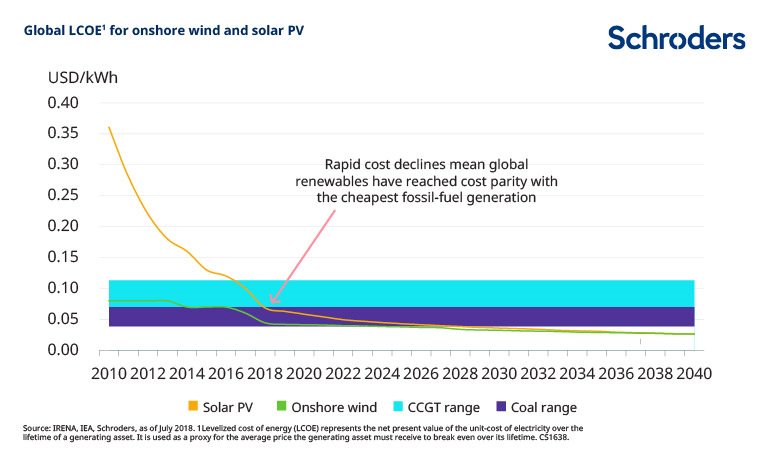
Finally, the Mark Lacey shows a chart, claiming that solar and onshore wind energy are now competitive with oil & gas:


As I’ve said, whenever that’s true – great news!! - businesses will voluntarily switch, and the greens will be happy. But the analysis is more complex than the author suggests. Saying “solar and onshore wind energy are now competitive with oil & gas” is just too simplistic – especially if he’s thinking of an energy revolution. Firstly, solar and wind cannot currently compete with fossil fuels as resources that can power all the businesses in the world economy. So they are not competitive with oil and gas with regard to most of the world’s industry. It’s a bit like saying the paddling pool in my back garden is big enough to provide water-based fun for my kids, therefore all the world’s kids can come and use my pool. It’s just not true – there’s a scaling problem – and similarly, solar and wind may be cost effective in a few cases (although that is still unproven at this stage, see above) but it’s a false comparison to say they are more competitive than coal and gas, because they are not yet wholly competitive with coal and gas in terms of resourcing the world’s industries.

On top of that, of course, is the fact that misallocating value-robbing resources into renewables will very likely impede the innovations that lead to the most efficient technological solutions. Subsidising renewables gives a false impression of their viability, and it disincentivises innovators from investing in proper cost-effective solutions. What’s the point of risking capital investment in innovative market-based solutions that will actually provide value when special handouts from the government to artificially valuable renewable alternatives make the race look about even, when really, minus the taxpayer handouts, renewables fall well short? There’s no point risking your investment in a race to make us greener against an opponent with an unfair advantage. You may be a faster cyclist, but your competitor has lobbied for a government hand out to turn his bike into a motor-powered machine, hiding the fact that he is a lot slower and less fit than you are.
 
That analogy is a bit like what the general public’s impression of the renewables vs. fossil fuel debate – they are seeing a false economy that robs entrepreneurs of as such incentive and motivation to use trade and competition as vehicles for making us markets greener. How ridiculous, not to mention duplicitous, to claim that solar is as efficient as fossil fuels and neglect to mention the massive governmental subsidies/taxpayer surcharges that fund this rentseeking. Is it dishonesty or stupidity? Either way it’s the same result. On the whole, then, your article is a textbook example of how not to reason, and how to wantonly fail in attempting a cost-benefit analysis.
Given that the present day redistributive aim is always to enable the better off to help the worse off, I’ve argued before that the majority of our weight should be put on helping present day poor people, and that we should put very little emphasis on future people who will be a lot better off than we are.  That seems obviously right to me, at least as strongly as the counter-proposition – that we should rob present day poorer people for the future richer people – seems obviously wrong.
 
Alongside that is the logical corollary: live with the costs that come alongside the much greater benefits of our industrial progression, and allow the freedom of exchanges of ideas to carry on uninhibited in solving the problems we face. There is no system we know of that works better – so accepting global warming and adjusting to the changes through the natural mechanism of the price system seems fairly obviously cheaper, more efficient, safer, less risky and less damaging than impeding innovation and slowing down progress with policies of which we hardly understand the costs.


Monday, 29 July 2019

Turning Up The Heat On Climate Change: Has No One Ever Considered That Global Warming Might Be A Good Thing?


Recently I wrote a paper explaining why I think the politics associated with climate change is both bad economics and bad philosophy. That paper was a mix of my overall theoretical interpretation of how reality operates, and the empirical facts that we observe through an economic lens when considering highly complex societies. I will be sharing that paper soon, albeit selectively - and not, I'm afraid, on this blog (for more details on that, you can email me - see the right hand side bar).

On the political side of this topic, the view I've always had - something that seems alarmingly obvious to me, but just alarming to environmentalists - is that the carbon emissions that have caused the anthropogenic parts of climate change confer astronomically more benefits on the world than they do costs, and you have to be rather short-sighted or wilfully blind to not realise this. So, then, this evening I saw a paper from Matt Ridley that caught my attention, about why he thinks climate change has done more good than harm. When he isn't talking about God or spurious notions of chance and randomness in biological evolution, I find he often talks sense - and a brief digest of his work leads me to agree with his views on global warming.

Exploring some of Ridley's sources led me to some further empirical data surrounding climate change, where even the scientific consensus has it that climate change is nothing like the emergency many fear it is, and that it is actually more beneficial to the world than it is costly. Incidentally, I wonder if anyone in the environmentalist camp has ever even considered whether global warming may actually be a net benefit, especially as the cold seems to have historically (and presently) been a much more inhibiting force to our progress and our survival than warmth.

Professor Richard Tol (do Google his work - there's plenty of it) has perhaps done the most of anyone I've researched to show how when you factor in the economic, the ecological, the humanitarian and the financial factors, there is an overall positive effect in climate change. He arrived at this conclusion after undertaking 14 different studies of the effects of future climate trends. One of professor Tol's key findings is that climate change would be beneficial up to 2.2˚C of warming from 2009 (when his paper was written). Some say those temperatures may not be reached until the end of the century, some say even longer. The IPCC predicts we will reach that temperature increase by 2080. This means that even at worst case scenario, global warming will continue to be of net benefit for another 60 years. So it's not exactly a climate emergency, is it? And even if it the case that global warming will only benefit us for another 60 years (assuming current conditions) then the people who will have to deal with in 2080 will be about nine times as rich as we are today (assuming economic growth continues on its present trajectory).

This is like a cherry on the top of my cake: you see, my paper only went so far as to say that even if climate change is doing more intrinsic harm than good from a relatively isolated perspective, once you factor in all the economic and scientific benefits to the equation, we sit on a net positive. But further research indicates that even the changing climate itself has engendered more positives than negatives. That said, while I'm encouraged by Richard Tol's research, I think he slightly underestimates the mood for optimism by making a fairly big underestimation himself. He talks of global warming possibly being a problem by the time the planet undergoes 2.2˚C of warming (in 2080) without paying enough regard to just how much better equipped we'll be in 60 years from now to tackle perceived problems in 2009 (or even 2019). As an economist who mainly focuses on the cost-benefit analyses to do with climate change - trying to factor in all matters of consideration - digging deeper in to the scientific research (which isn't all that important, by the way, because these are largely economic questions, not scientific ones) has been encouraging to my cause.

This has always been a strange solecism from climate change alarmists too: Look at how the world has gone from 1919 to 2019. Nobody sane thinks that the world's population hasn't benefitted immensely from industrial progression and technological advancements alongside a changing climate during the past 100 years. So given that we are richer and more advanced in this day than in 1919, why are so many people unconvinced that the world's population won't benefit immensely from industrial progression and technological advancements alongside a changing climate in the next 100 years? Moreover, given that we in 2019 have most of the advancements to have been able to solve the majority of economic problems people in 1919 faced, why are we not more confident of having similar capacities 60 years henceforward, given that we are starting from an even stronger place, and that we have far more people on the planet to help solve the problems that might arise? We seem drastically unfair on ourselves when it comes to forecasting our ability to work together to solve problems.

Here's another angle on the benefits from Matt Ridley:

"The chief benefits of global warming include: fewer winter deaths; lower energy costs; better agricultural yields; probably fewer droughts; maybe richer biodiversity. It is a little-known fact that winter deaths exceed summer deaths — not just in countries like Britain but also those with very warm summers, including Greece. Both Britain and Greece see mortality rates rise by 18 per cent each winter. Especially cold winters cause a rise in heart failures far greater than the rise in deaths during heatwaves. Cold, not the heat, is the biggest killer. For the last decade, Brits have been dying from the cold at the average rate of 29,000 excess deaths each winter. Compare this to the heatwave ten years ago, which claimed 15,000 lives in France and just 2,000 in Britain. In the ten years since, there has been no summer death spike at all. Excess winter deaths hit the poor harder than the rich for the obvious reason: they cannot afford heating. And it is not just those at risk who benefit from moderate warming. Global warming has so far cut heating bills more than it has raised cooling bills. If it resumes after its current 17-year hiatus, and if the energy efficiency of our homes improves, then at some point the cost of cooling probably will exceed the cost of heating — probably from about 2035, Prof Tol estimates."

And then there are the myths about the weather:

"Well yes, you may argue, but what about all the weather disasters caused by climate change? Entirely mythical — so far. The latest IPCC report is admirably frank about this, reporting ‘no significant observed trends in global tropical cyclone frequency over the past century … lack of evidence and thus low confidence regarding the sign of trend in the magnitude and/or frequency offloads on a global scale … low confidence in observed trends in small-scale severe weather phenomena such as hail and thunderstorms’. In fact, the death rate from droughts, floods and storms has dropped by 98 per cent since the 1920s, according to a careful study by the independent scholar Indur Goklany. Not because weather has become less dangerous but because people have gained better protection as they got richer: witness the remarkable success of cyclone warnings in India last week. "

Not only is it the case that the climate change alarmists are trying to kill the geese that are laying the golden eggs that really are sorting out the problems they want to solve, the situation is even worse. The policies they are instituting to fight climate change are doing mass harm around the world, especially in the world's poorest countries. It's basic econ 101 that the cheaper and more readily available food and fuel is to the world's poorest citizens, the better their lives will be. Yet climate change policies drive up prices for energy, fuel and food, and hinder competition to provide these things at lower prices - and this has devastating effects on young people trying to eat in northern Africa right through to old people trying to heat their home in northern England.

I learned from Bjorn Lomborg that the European Union will pay £165 billion for its current climate policies each and every year for the next 87 years, and from Matt Ridley that Britain’s climate policies - subsidising windmills, wood-burners, anaerobic digesters, electric vehicles and all the rest - is due to cost us £1.8 trillion over the course of this century. And here's the worst statistic of all - consensual expertise has it that every £100 spent fighting climate change brings just £3 of benefit. Furthermore, the efforts to mitigate climate change through campaigns for emissions reductions are having a negative effect on food security, due to indirect impacts on prices and supplies of key agricultural commodities.

All this stuff boils down to basic economics really, and a shocking indictment of the climate change hysteria that it seeping into our politics. Carbon emissions happen alongside of, and because of, our industrial achievements and or economic growth. Therefore setting an arbitrary date to produce net zero carbon emissions is foolish because the cost-benefit analysis is far too complex to be pinned to a date that's thought up on a whim by politicians. You can't artificially reduce carbon through some political fiat without destroying capital, undermining investments and harming value-creating production. This is a solid argument for not imposing short-sighted targets, but instead leaving it to highly competitive industries to become greener through the natural mechanisms of competition and innovation in relationship with the law of parsimony - something they've been doing quite naturally, and remarkably well, for the past 150 years.

I have no objection to the notion that some of the scientific predictions may come to pass - but even if they all come to pass, the alarmists are grossly underestimating the future technological advancements, and how our future selves will be equipped to respond. Here's a better way to think of it. There are certain, immense benefits to our industrial activity, some certain costs, some other probable costs and some other probable benefits - and anyone who tells you they've figured out the net costs and benefits for the next few decades in this complex equation of numerous unknowns, and can then show that there is a net cost and that they have a solution to it, is being dishonest and somewhat delusional. Maybe we should confer tax breaks to the biggest carbon emitting businesses, not tax penalties. It sounds absurd, and perhaps it is, but it may not be. Our industrial and technological revolutions have conferred so many benefits on the planet that it seems more imprudent to punish and discourage them than to encourage them, as long as we ensure that negative externalities are penalised whenever the action is efficient. 

Wednesday, 24 July 2019

Toilet Seat Economics: Lifting The Lid On The Optimal Marital Policy


Every married couple knows that the most important question of all isn't 'Why is there something rather than nothing?", or "What is reality?" or "Will we ever fully understand consciousness?" - it is this epic question:

"Should men put the toilet seat down after they'd had a wee?"

I jotted down some thoughts, and my friend Tim Reeves commented. For anyone interested, here is our discussion:

Toilet Seat Economics
JK: You know the scene; Jack and Jill get married, and they have that discussion about what the toilet seat policy should be in the marital home. Jill usually says "Please leave it down after you use it", and Jack can respond in different ways. He can refuse in a carefree way (that's not going to help the relationship), he can acquiesce in a resentful way (that's not the best response either), he can refuse in a logical way (more on that in a moment) or he can acquiesce in a cooperative way because he loves her. One of the latter two ways is best - and I'm going to explore which one it is.

This kind of scenario is often thought of in terms of game theory strategy - but husbands who think this way are making an amateur mistake. In game theory, a state called the Nash equilibrium occurs when no agent in a situation can improve their strategy by unilaterally changing their actions. The optimal outcome of a situation is where there is no incentive to deviate from the initial strategy once he or she knows their opponent's decision. In the well known prisoner's dilemma, for example, the Nash equilibrium is not for both of you to remain silent. The Nash equilibrium in the prisoner's dilemma is for both you and Jill to betray each other, because even though mutually staying silent leads to a better outcome, if one chooses betrayal and the other stays silent, one of you has a worse outcome. In other words, the rational decision is to betray, because betraying can't make your situation worse, but it might make it better.

This also shows that rational decisions don't always lead to good outcomes. Imagine you're Jack. If Jill betrays you and you remain silent, you get three years in prison by not betraying Jill, and two years in prison by betraying her. Therefore it's better for you if you betray Jill. If Jill stays silent and you betray Jill you walk free, and if you also remain silent you receive one year in prison. Therefore it's still better if you betray Jill, and the Nash equilibrium occurs if you both betray each other. However, a husband and wife with a healthy relationship are a cooperative unit, not in competition, so Nash equilibria does not apply here, because it only applies when two agents are in competition.

TR: Agreed. What is “rational” here really depends on whether or not we are dealing with a single organism or two competing organisms. For organically joined players the cooperative strategy is the rational one, but for two separate competing organisms betrayal is the rational choice.

JK: And thankfully, married life need not be like a prisoner's dilemma - it should be an opportunity to bless each other, although sometimes the mathematics is fun too. To see why the toilet seat issue is an even bigger chance to bless each other than is often realised, let's assume for a second that the husband and wife are treating the toilet seat issue in a competitive prisoner's dilemma-style scenario. In competition, where the strategy is to touch the toilet seat as infrequently as possible, you'll find that acquiescing to the lady's request to always leave the toilet seat down is inefficient. Leaving the toilet seat the same as after you've used it is the most efficient system.

Here's why. If you leave it always down then any time the man goes consecutively he is inconvenienced by having to move it up again, even though he used it last. Similarly if you leave it always up, any time the woman goes consecutively she is inconvenienced by having to move it down again. Leaving it always down is inefficient to males; leaving it always up is inefficient to females; and leaving as you used it the most efficient system.

But we are only looking at this situation from the perspective of minimising the joint total cost, where cost is touching the toilet seat unnecessarily. The mathematics is fairly easy to enumerate on this: assuming for simplicity that both Jack and Jill use the toilet exactly the same number of times, then if both Jack and Jill leave the seat up every time they use it, both will touch it the most, and Jill will touch it about six times more than Jack, making it the least efficient of all. If the decision was decided by a coin toss, then both Jack and Jill should touch it roughly equal number of times, but they will jointly touch it the second most occurrences.

If Jack leaves it the opposite of how he found it, he will touch it about 75% of the time, and Jill 25% of the time; If Jill leaves the opposite of how she found it, she will touch it about 75% of the time, and Jack 25% of the time - and in both cases they will jointly touch it less than the two cases above. The last option though - leaving it as you last used it - is the most efficient way to minimise the joint total cost. Because Jill only needs it down, and Jack needs it both up and down, he will touch it a little more often than Jill will, but they will both jointly touch it the least often.

However, all this only factors in the scenario that Jack and Jill go equally and alternatively. If we allow for the fact that for all sorts of reasons, like different liquid consumption, and different times they are in the house, there will be many times when Jack and Jill will go consecutively, and that's even stronger argument for leaving it as you last used it. Take an extreme case: suppose Jack drinks lots of water and goes to urinate 5 times for every 1 time that Jill goes, then a policy in which he put the seat down every time for Jill means he is putting it down and then back up again 4 times, with him being the only one who has used it during that time.

Conclusion: leaving it as you last used it is the best policy for Jack and Jill.

Now, here's the rub: it's not quite that simple, because love is about more than logical reasoning - it is about putting each other first. A couple whose strategy was simply to minimise the joint total costs would quite naturally adopt the policy of leaving the toilet seat as you last used it.

TR: Conventional water closets get visited by two kinds of people. Namely “Down Persons” (=D) and “Up Persons”. You notice that I haven’t distinguished between male and female. When a male goes to the toilet he can be in either an “up” state or a “down” state; so as far as toilet usage is concerned he’s two different people in the up state and down states. Because we are thinking of the overall organic economy of the household we need not make the distinction between male and female just yet; in fact it’s a distraction from the core mathematics. So if we assume that Up and Down persons visit the cubicle in some pattern of visits we can represent that pattern as something like this:

DDDDDUDDUUDDDUDDDDDUDDDDDUUUD….etc

The troublesome configurations are the pairs UD and DU as they entail the expenditure of energy and time by the household in order to change the state of the toilet seat. Interesting to note that it doesn’t matter who puts the seat up or down as the expenditure in energy & time is the same.  A D-person could put the seat up in advance just prior to the visit of a U-person. Or alternatively a U person visiting the cubicle could put the seat up after a D person has used it. (It’s contrariwise for the configuration UD, of course) The point is that in terms of time and energy it doesn’t make any difference whether U or D makes the necessary changes to the state of the toilet seat.

But there is a big “but” with what I have just said: It assumes that the pattern of visits is predictable to the extent that a householder knows whether the next visitor is an Up or a Down. This assumption, of course breaks down if the pattern of visits is random, in which case a cubicle user will not know whether the next user is U or D.

So what is the most household efficient strategy if the pattern is random? In this case the householder doesn’t know whether the next visitor is a U or a D. Hence if a householder changes the state of the seat after using it in preparation for the next visitor this may well be wasted time and energy, because the next visitor who comes in at random may have to wastefully change its state back to what it was. Because a user cannot anticipate whether the next user is a D or a U that user is not the best person to change the state of the seat because that state may have to be undone. The best person is of course the next person who visits the cubicle because they obviously know their requirements best and therefore no tricky precognition is needed by the previous visitor!

So to summarise, I agree that your strategy, which involves the last visitor leaving the toilet seat in the state he/she used it, is the most efficient scenario timewise and energetically.

JK: Moving on from mere economic efficiency to blissful marriage efficiency, a good strategy would be to supersede the good strategy with a better strategy whereby the husband insists on putting the toilet seat down for his wife. One objection might be that if the basis of a successful marriage is for each to put the other one first, then letting Jack put the toilet seat down every time is to make him complicit in an erroneous cost-benefit scenario, and that is not really an example of Jill putting his needs first.

TR: I’d go along with the general sentiment here that if “putting the other first” leads to wasteful inefficient scenarios it’s not actually that “loving”. After all, the overall household economy affects both players and if wasteful practices are adopted all parties can be adversely affected in the long term. So we are looking for efficient cooperative strategies. However there are other factors at work. Toilet seat changes involve very little energy and time and so the extra energy and time used by, say, U putting the seat down for D may perhaps be worthwhile for relationship purposes and help cement ties which could be of overwhelming concern in an organic whole that depends on  a cooperative household economy.

JK: The way to optimise this situation in accordance with mutual regard for the other, then, is to have a discussion with your beloved and agree on what is most important to them about this scenario, and who cares the most (because it will vary couple to couple). Because economics is primarily a study of human behaviour, and human behaviour is conditioned by our feelings, then your optimal system in the marital home must factor in levels of importance for each beloved. For example, in a typical marriage I'd predict that a lady cares a lot more about not having to touch the toilet seat than a man does about having to lift it up, so the most maritally efficient, and therefore also the most economically efficient in this case, is for Jack to show love and put it down after use, for Jill to love him gratefully in return for doing so, and for her to forgive him if he forgets from time to time, because she knows his intentions are the best for her. 


/>